

Replacement Theology
A Dangerous Doctrine of Spiritual and National Subversion

It is not this…..
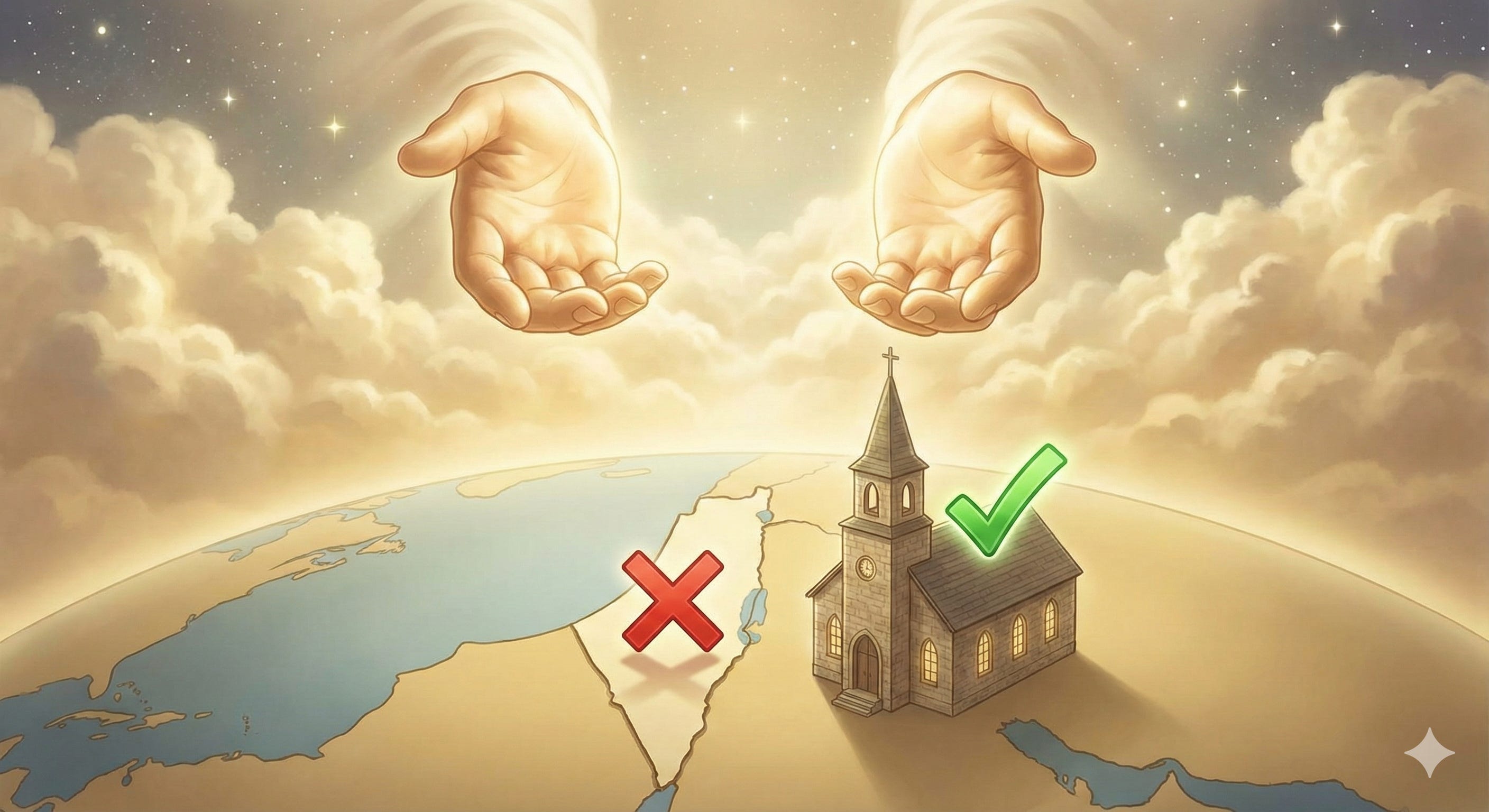
But this….
Replacement Theology, more accurately termed Supersessionism, is a theological framework asserting that the Christian Church has entirely superseded national Israel as the exclusive bearer of Yahweh’s covenants and promises. This essay will trace its historical development, its transnational transfer as a tool of power, analyse its distinction from Covenantal Theology, and argue that its modern political application by certain groups edges perilously close to a form of idolatry.
The Historical Genesis of Supersessionism
The roots of Replacement Theology are found in the early centuries of the Church, emerging as a polemical tool against Judaism. Following the destruction of the Second Temple in AD 70 and the Bar Kokhba revolt (AD 132-135), early Church Fathers, such as Justin Martyr and Origen, began to articulate a theology that framed the Jews’ political misfortunes as divine punishment for their rejection of Christ. They argued that Christians—comprising both Jews and Gentiles who accepted Jesus as the Messiah—were now the “true Israel,” the spiritual inheritors of the blessings promised to Abraham.
This theology was systematised and cemented by figures like Augustine of Hippo in the 4th and 5th centuries. In his work “Against Faustus”, Augustine advanced the idea that the Jews were preserved as a people only to serve as “witnesses” to the truth of Christian prophecy, living in a state of perpetual punishment. The Church, as the “City of God,” had fully replaced the earthly, carnal Israel. This theological shift provided the ideological justification for centuries of ecclesial and secular anti-Jewish policies throughout Christendom, from the Crusades to the ghettoisation of Jews in Europe. It effectively spiritualized away the concrete, national promises Yahweh made to a specific ethnic lineage, transferring them to a universal, non-ethnic body.
Supersessionism vs. Covenantal Theology
It is critical to distinguish classical Supersessionism from Reformed Covenantal Theology (or Covenant Theology), as the two are often erroneously conflated. While both views see a strong continuity between the Old and New Testaments, their handling of national Israel differs significantly.
Replacement Theology (Supersessionism) posits a nullification of Yahweh’s promises to ethnic Israel. It teaches that Israel was permanently disinherited due to its unbelief, and the Church becomes a completely new and separate entity that has taken Israel’s place. The covenants are transferred, and national Israel has no unique prophetic future; all prophecies are spiritually fulfilled in the Church. This view sees a decisive break.
Covenantal Theology, in its mainstream Reformed expression, posits a development and expansion of the covenant of grace, not a nullification. It views the Church as the continuation of the one covenant people of God throughout history, comprising believers in all ages. This framework often uses the term “Israel” to refer to the entire covenant community, which includes both believing Jews and Gentiles. However, a crucial distinction within Covenant Theology is its recognition of a future, large-scale conversion of ethnic Israel (Romans 11:25-27). It does not teach that God has abandoned His ancient people entirely, but that they remain in a state of temporary hardening until the full number of the Gentiles has come in. The promises are not transferred away from Israel; rather, the Gentiles are grafted into the blessings of Israel’s covenants (Romans 11:17-24), and Israel itself will eventually be grafted back in.
Thus, while Covenantal Theology spiritualizes the application of many promises to the multinational Church, it typically retains an expectation of a future for ethnic Israel that Supersessionism explicitly denies.
The Transnational Transfer of a Paradigm
The potency of Replacement Theology lies in its adaptability. It is fundamentally a paradigm of supersession—the idea that a new, true entity can displace and invalidate an old, corrupt one. This paradigm was not confined to religion. With the rise of the modern nation-state and secular ideologies, the same supersessionist logic was transferred from the spiritual realm to the political and ethnic.
The most explicit and devastating transfer occurred with the rise of Marxist and neo-Marxist ideologies. Just as the Church Fathers claimed to be the “true Israel,” these ideologies posit a “true people”—the international proletariat—who will supersede the “old” nations and ethnicities. Concepts like “cosmopolitanism” and the dismissal of national sovereignty and borders as archaic constructs are direct secular analogues of supersessionist theology. The goal is the eradication of particular identities in favour of a universal, homogenous class or, in its modern form, an eradicated global citizenry.
This ideological framework justifies policies of mass immigration and demographic change, often referred to as the “Great Replacement.” The architects of these policies, whether consciously or not, operate on a Replacement Theology model: the “old” nation, with its specific ethnic and cultural character, is deemed flawed, racist, or obsolete, and must be replaced by a new, diverse populace. The nation is no longer seen as an organic, ancestral inheritance to be stewarded, but as a political space to be re-engineered.
The Idolatry of the Accusers
The most profound danger arises when those who champion this secular replacement accuse their opponents of theological error. It is common to hear Christian leaders and institutions that support open borders and demographic transformation label traditionalists and nationalists as adherents of a heretical “Replacement Theology” because they affirm God’s continued covenant with the biological descendants of Jacob.
This accusation is a profound inversion and approaches idolatry. Idolatry, at its core, is the worship of a creation—an idea, a system, a political program—rather than the Creator (Romans 1:25). By elevating their political project of globalised humanity to the level of divine mandate, these accusers make an idol of their ideology. They conflate the kingdom of God with a specific, man-made political vision of borderless societies.
In doing so, they commit the same error as the original supersessionists, but in reverse. Whereas early supersessionists spiritualized away God’s earthly promises to a specific people, these modern ideologues politicise God’s spiritual kingdom, reducing it to a program for demographic dissolution. They replace the divine order of nations, established after Babel (Acts 17:26), with a humanistic ideal. To accuse a Christian of heresy for loving his people and seeking to preserve his nation’s demographic integrity is to claim a false spiritual authority for a worldly agenda. It places a political orthodoxy above Scriptural fidelity, which is the essence of idolatry.
Fulfilled vs Replaced
The critical error of the early church fathers was that they failed to understand the significant difference between these two words. Jesus fulfilled Israel; He did not replace Israel.
(Shadow vs. Substance):
Think of the Old Testament ceremonial laws as a shadow of what was to come. A shadow is a real outline of a person, but not the person themselves. When the person (Jesus) finally appears, the shadow is “fulfilled.” The shadow isn’t “replaced” by a stranger; it is realised by the substance of the person casting it.
Matthew 5:17 LSB “Do not think that I came to abolish (replace) the Law or the Prophets; I did not come to abolish but to fulfill.
Jesus could not be more unambiguous.
This fatal error by the church fathers was a serious blunder prompted by the right motives, but misplaced in its application.
“It Is Finished”
This was the famous statement by Jesus in John 19:30, but it begs the question, “What is ‘it’?” In my humble opinion, Jesus was indicating that all that was prophesied in Daniel 9:24 was “it”.
Daniel 9:24 LSB “Seventy weeks have been determined for your people and for your holy city, to finish the transgression, to make an end of sin, to make atonement for iniquity, to bring in everlasting righteousness, to seal up vision and prophecy, and to anoint the Holy of Holies.
The Role of Satan as a Deceiver
Satan’s role in the early church deception centred on gradually replacing the primacy of Scripture with extra-biblical tradition.
The apostles consistently warned that a “falling away” would occur shortly after their deaths. Satan exploited this transition by influencing early fathers, including Origen and Clement, to introduce allegorical interpretation, obscuring literal prophetic fulfilment. This paved the way for doctrines like papal supremacy, which reinterpreted Daniel’s little horn away (Daniel 7:8) from the historical papacy.
Satan’s primary tactic was shifting authority from Scripture alone to church councils and apostolic succession claims. This created a system where tradition could override biblical clarity, particularly on prophetic timelines and the nature of the antichrist. The merger of church and state under Constantine further institutionalised these deviations, embedding pagan influences into Christian practice.
The result was a gradual obscuring of key truths: the fulfilled timeline of Daniel 9, the identity of the beast powers, and the primacy of individual regenerate believers over institutional hierarchy. Satan worked through incremental theological compromises that ultimately separated the visible church from its apostolic foundation.
Conclusion
Replacement Theology began as an ecclesial doctrine that severed Christianity from its ethnic roots in Israel, with tragic historical consequences.
Under the influence of the great deceiver, the early church became so enamoured with its councils and majority opinion that the essence of the Gospel of Jesus was completely lost, finding its consummation in the abomination of the papacy.
Millions have been slaughtered at the hands of this beast, and if that was not “persecution”, I do not know what persecution is. Our modern form of lukewarm church embraces it as genuine “Christianity”, just because they say the name of Jesus. Every writer in the New Testament warned against false prophets, but we ignore the warnings and embrace anyone who says “Jesus”.
The second beast of Revelation 13 has yet to be fulfilled, but I see the threads in the Catholic influence within the new US regime:
Revelation 13:11-12 LSB Then I saw another beast coming up out of the earth, and he had two horns like a lamb and he was speaking as a dragon. (12) And he exercises all the authority of the first beast in his presence. And he makes the earth and those who dwell in it to worship the first beast, whose fatal wound was healed.
Oh, how far we have fallen.
Yahweh knows the end from the beginning. We are just wet clay in the hands of the Master potter:
Isaiah 46:9-10 LSB “Remember the former things long past, For I am God, and there is no other; I am God, and there is no one like Me, (10) Declaring the end from the beginning, And from ancient times things which have not been done, Saying, ‘My counsel will be established, And I will accomplish all My good pleasure’,
Blessing,
Geoff
"the LORD appeared to him from far away. I have loved you with an everlasting love; therefore I have continued my faithfulness to you." Jeremiah 31:3 ESV
GOD bless you, Geoff. I love you, brother.
Our Father (Avinu) - a song of praises
https://www.youtube.com/watch?v=ZQUGT_u8WPU
Can't wait to read this today…Thank you